
Straps and buckles from the 100buy Spreadsheet, matched to the webbing
Buckles, adjusters, rings, clips and cap closures. Nearly every part on this page is named after the width of the strap it holds, so that is the number to take before anything else.
Bag straps, swivel clips and the width of the webbing
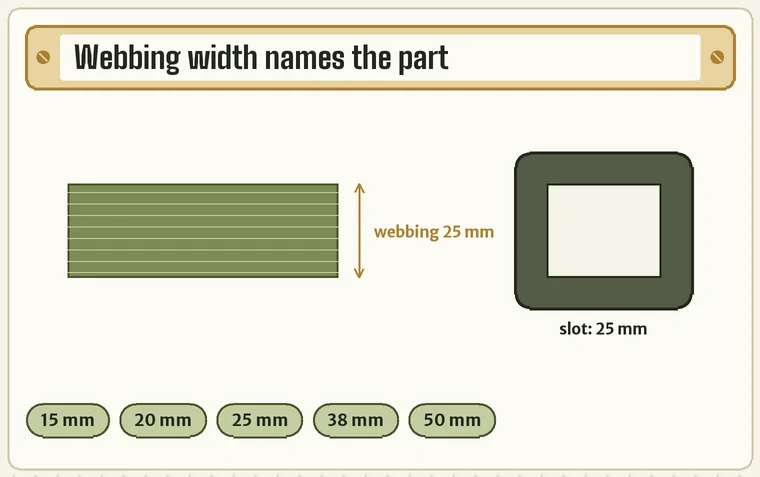
Almost every strap part on a bag is sized by one measurement: the width of the webbing it holds. A buckle labelled 25 mm takes 25 mm webbing, even though the buckle itself is visibly wider than that. The widths you meet most are 15, 20, 25, 38 and 50 mm, with 32 mm and 30 mm turning up less often; 25 mm is roughly an inch and 38 mm roughly an inch and a half.
So measure the webbing flat, straight across, not the old buckle. Thickness matters a little too: a thick, stiff webbing can jam in a buckle designed for thin strapping of the same width, which is why parts sellers sometimes list both. Strap parts are usually sold in packs by width, and an option that only says “black” without a width is the one to avoid.
Side-release buckles, ladder locks and tri-glides
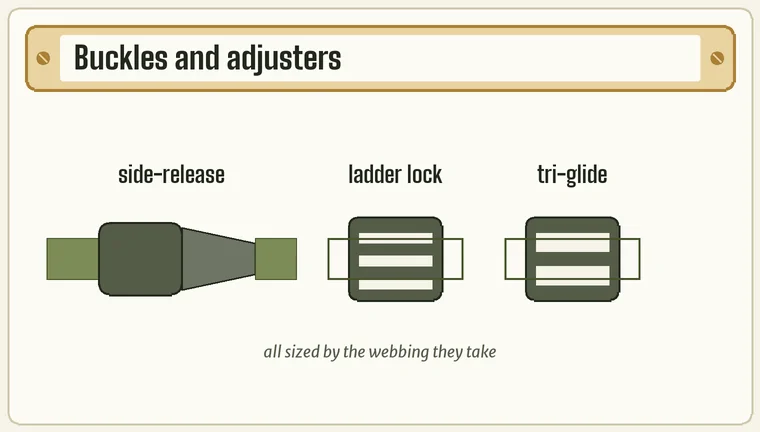
The side-release buckle, the clip you squeeze at the sides, is the strap part that cracks most often on rucksacks, usually on the chest strap or hip belt. A replacement is easy if the webbing end is loose; if the strap is sewn into a loop, look for field-repair buckles, which have a removable screw pin or a split bar so they can be fitted onto a sewn loop without unpicking anything.
Ladder locks and tri-glides are the adjusters that let a strap lengthen and shorten. They thread onto the webbing without sewing, so they are the simplest strap parts of all to replace. Both are sized by webbing width, like the buckle. Check that the male and female halves of a side-release buckle come together in one option, because some listings sell them separately.
D-rings, swivel clips and the strap they carry
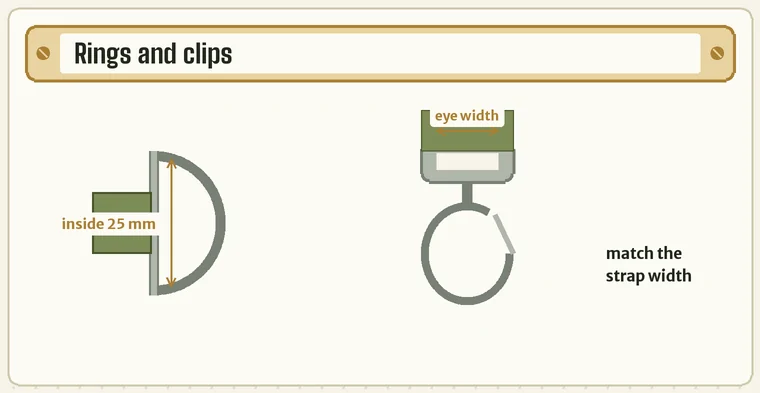
Shoulder bags hang from D-rings and swivel clips. Both are sized by their inside width: the straight side of a D-ring and the eye of a swivel clip must be at least as wide as the strap that passes through. A 25 mm strap needs a 25 mm ring; a 20 mm clip on a 25 mm strap will bunch and wear through.
Swivel clips fail at the spring gate or at the swivel itself, so a replacement clip is often the whole fix for a bag with a good strap. Match the metal finish (silver, gold or black) if the other hardware on the bag shows, and check the clip’s gate opens wide enough for the ring it hooks onto. As everywhere in this drawer, only plain clips belong here: none with lettering cast into the metal.
Cap closures: snap strap and slide buckle
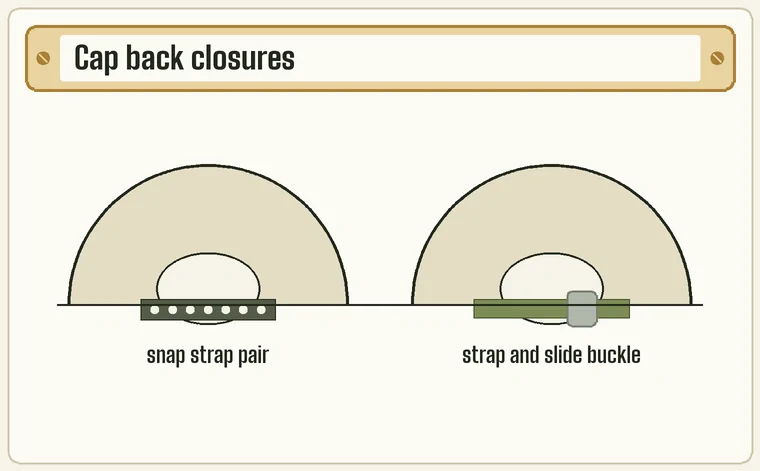
The back of a cap closes in one of a few standard ways. A snap strap is a pair of moulded plastic straps, one punched with holes and one with pegs, often with seven adjustment holes. A strapback uses a fabric or leather strap through a metal slide buckle. Others use hook-and-loop tabs or an elastic band inside the sweatband.
Snap straps break at the pegs, and they are sold as pairs, often several pairs to a pack, because they are a standard part. Fabric straps come as a strap-and-buckle set sized by strap width. Either way, fitting means sewing the new strap into the opening at the back of the cap, so this is a part for someone comfortable with a needle and thread. The sweatband inside the crown can be replaced too, sold by length, but that is more stitching still.
Split rings and clips on the key ring shelf
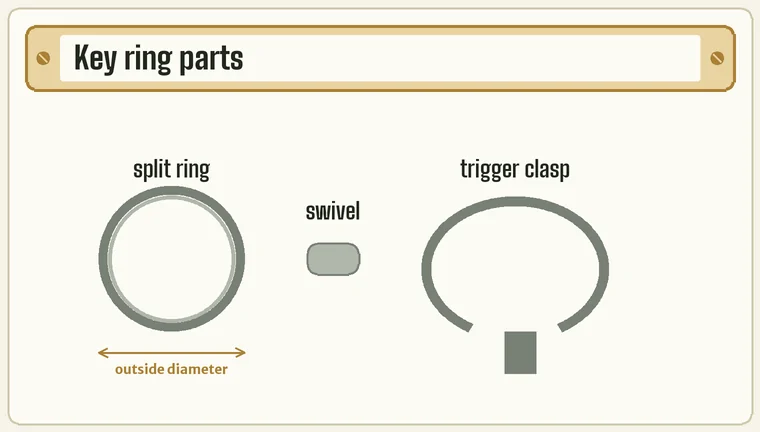
Key rings fail in two places: the split ring opens up under the weight of keys, and the clasp’s spring goes slack. Split rings are sized by outside diameter and by the thickness of the wire; a ring that is too thin for a heavy bunch of keys will spread again. Clasps on key rings are the large end of the lobster clasp range, often called trigger clasps, with a lever big enough for a thumb.
A small swivel between the clasp and the ring stops a bunch of keys twisting the whole chain. All three parts are sold in mixed packs, and the catalogue’s key ring shelf is full of novelty charms that come off and leave a perfectly good ring behind. As with jewellery, a findings pack with plain rings and clasps is the useful buy, and the findings drawer covers the smaller sizes.
Belt buckles without a mark
A belt buckle is sized by the width of the strap it takes, measured across the leather or webbing. Pin buckles have a prong through a hole in the strap. Some buckles are held on by a screw or press studs, which makes them the easy kind to swap without tools; others are stitched in.
This drawer only covers plain buckles: a buckle carrying initials or a maker’s shape is part of someone else’s trademark rather than a spare, and it is not a part we list or explain how to find. The catalogue’s belt shelf is linked here for the straps themselves. When you measure, measure the strap rather than the old buckle, and check the depth of the buckle too: a thick leather strap needs a buckle deep enough to pass through.