
Frames and watches in the 100buy Spreadsheet: nose pads, screws and straps
The small metal parts on glasses and watches. Nose pads go by mount type, hinge screws by diameter, straps and spring bars by lug width, and none of them needs the frame or the watch to travel.
Nose pads, hinge screws and temple tips for frames
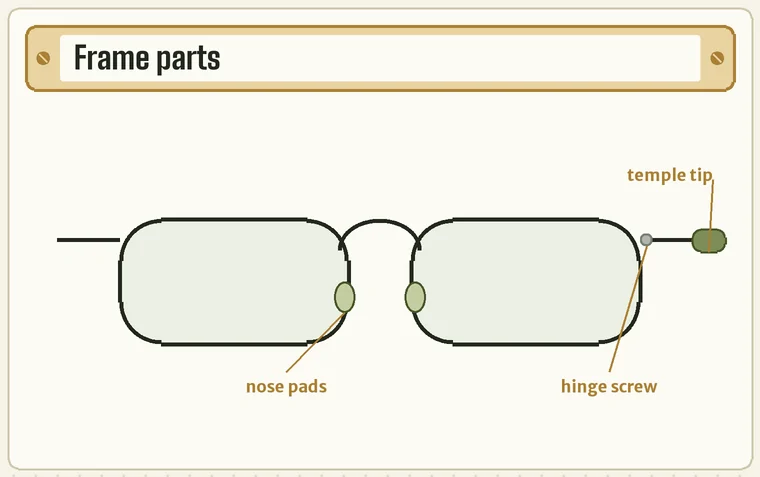
A pair of glasses has three parts that wear out long before the frame: the nose pads, which harden and yellow; the hinge screws, which work loose and fall out; and the temple tips, the plastic sleeves behind the ears, which crack. All three are standard, sold in packs, and fitted with a jeweller’s screwdriver at most.
This page covers those frame parts only, not lenses. Lenses are made to a prescription and belong with an optician, and this drawer does not cover them. For sunglasses from the glasses shelf the same three parts apply. Plastic frames without pad arms have their pads moulded in, so only the screws and tips are replaceable on those.
Screw-in, push-in and slide-on pad mounts
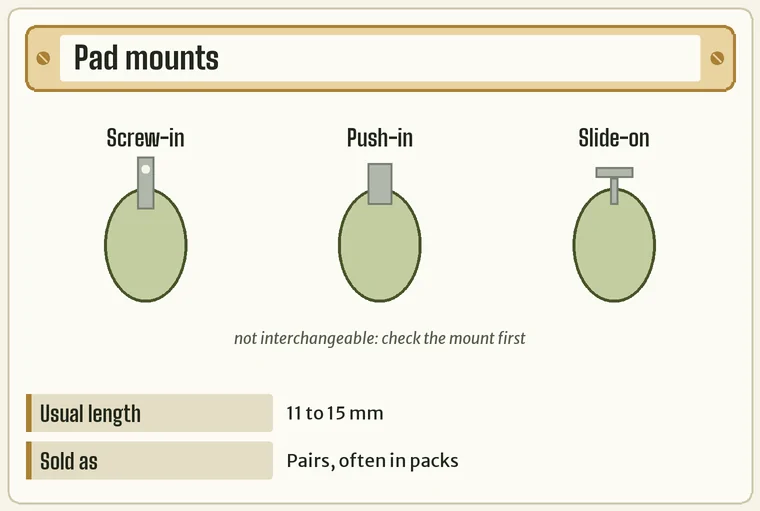
Before size, check how the pads attach, because the three mounts are not interchangeable. Screw-in pads have a small tab with a hole that a tiny screw passes through on the pad arm. Push-in (snap-in) pads have a rectangular boss that clicks into a little box on the arm. Slide-on pads have a T-shaped base that slides into the mount. A screw-in pad will not fit a push-in arm however close the size.
Some dual-mount pads are made to fit either screw-in or push-in arms, which helps if you cannot tell. Once the mount is known, measure the old pad along its longest side; most are 11 to 15 mm. Silicone pads are soft and grippy, harder plastic ones last longer, and either comes in pairs, often several pairs to a pack. When refitting a screw-in pad, stop turning the screw as soon as the pad stops rotating; one turn more strips the thread.
Hinge screws by diameter
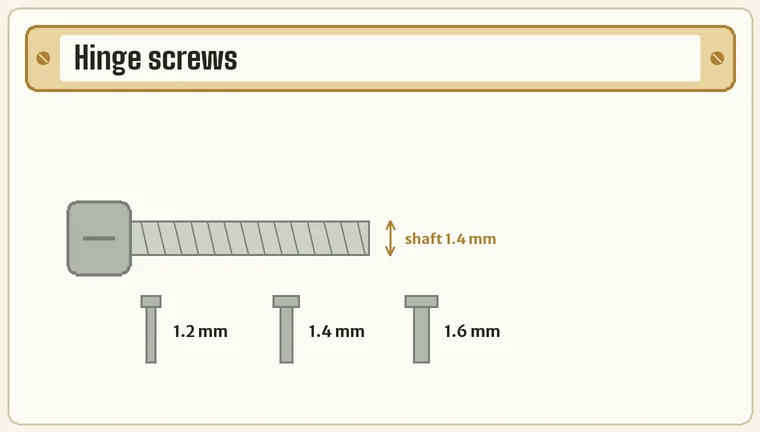
Glasses screws are tiny metric screws, named by the diameter of the shaft: M1.4 means 1.4 mm. That is the most common hinge size on metal and plastic frames, with 1.2 mm on thin or rimless frames and 1.6 mm on heavier ones. Nose pad screws are smaller again, around 1.0 to 1.2 mm.
Because you rarely know the size of a screw that has already fallen out, mixed packs of several sizes are the practical buy, usually with a tiny screwdriver. If a screw keeps working loose, the thread in the hinge may be stripped; the usual fix is to try the next size up in diameter. Self-tapping repair screws are sold for that situation too. A typical repair kit mixes 1.0 and 1.2 mm pad screws with 1.4 mm hinge screws, which covers most frames in one purchase.
Watch straps matched to lug width
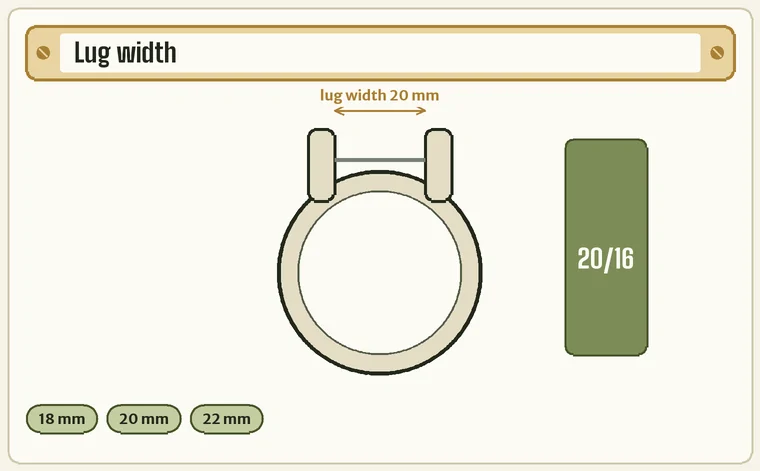
A watch strap is bought by lug width: the inside gap between the two lugs where the strap end sits, in millimetres. It is not the case diameter and not the outside span of the lugs. Take the strap off and measure between the inner faces of the lugs with a caliper, coming in from underneath; if the reading wobbles, the smallest one is the true width. 18, 20 and 22 mm are the most common.
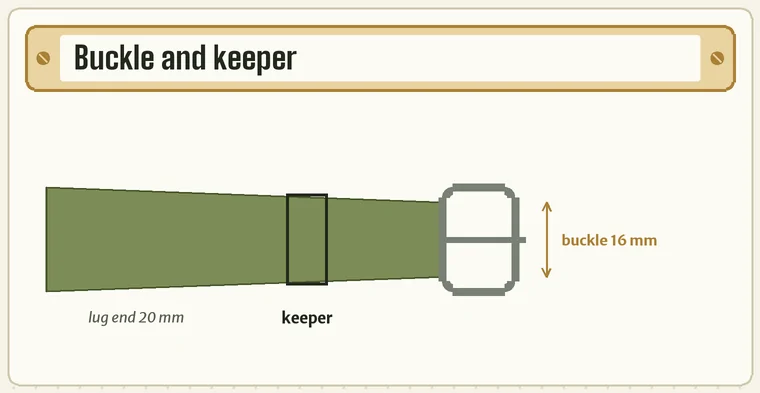
Straps often carry two numbers, such as 20/16: 20 mm at the lugs, tapering to 16 mm at the buckle. Odd widths like 19 or 21 mm exist, and a 20 mm strap squeezed into 19 mm lugs will bunch. Straps made for one particular smart watch model fit by model rather than by lug width, and they are not covered in this drawer; ordinary straps on the watch shelf are.
Spring bars and quick-release pins
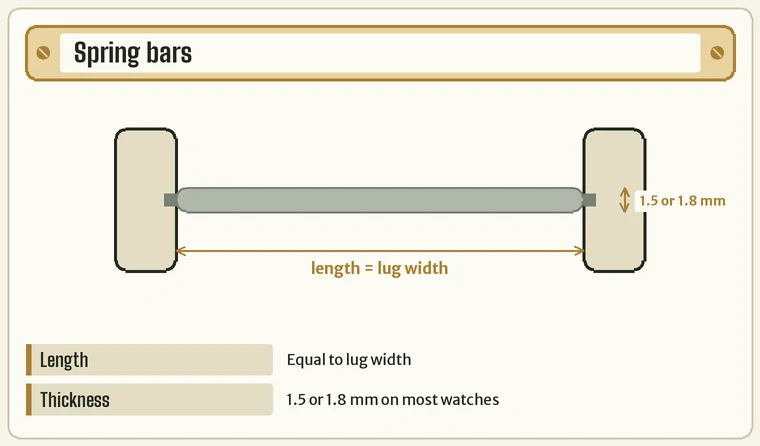
A spring bar is the sprung pin that holds the strap between the lugs. Its length should equal the lug width, within a couple of tenths of a millimetre: too short and it drops out, too long and it will not seat. Its thickness has to suit the lug holes; 1.5 mm and 1.8 mm cover most watches, and chunky diving-style watches can take 2 mm or more.
Quick-release bars have a small lever so a strap can be swapped by hand, and many straps now come with them fitted. On tight lugs or thick straps an ordinary bar can sit more neatly. Spring bars are sold in packs of several pairs by length, so it is worth buying a pack with any new strap: an old bar that has been bent once is the usual reason a strap falls off.
Buckles and keepers on a strap
The buckle sits at the narrow end of a tapered strap, so it is sized by the tail width, not the lug width: a 20/16 strap takes a 16 mm buckle. Pin buckles are held by their own small spring bar, which is why a buckle pack often includes a couple of short bars.
Keepers, the loops that hold the strap’s loose end, are sized by the strap width where they sit and by its thickness; a keeper for a thin leather strap will not stretch round a padded one. Both parts are cheap and sold in packs, and both are worth replacing before the strap itself, which is often still sound when the keeper has split.