
Jewellery findings for pieces bought through the 100buy Spreadsheet
The clasps, jump rings and earring backs that fail long before the chain or the earring does, with the measurement each one is sold by.
Jewellery findings: clasps, jump rings and earring backs
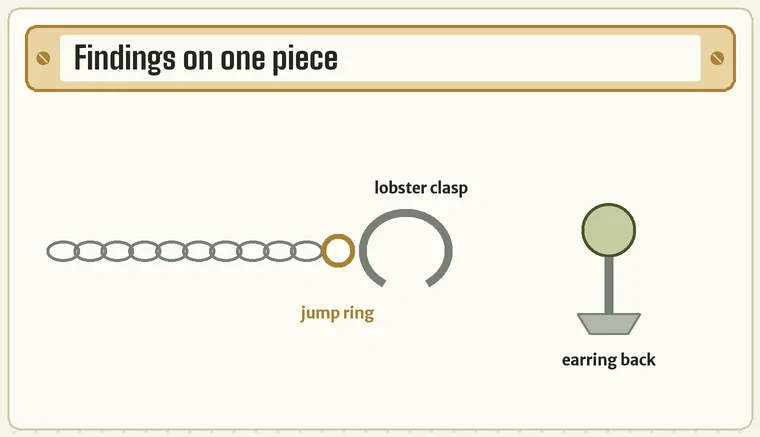
“Findings” is the jewellery trade word for the small metal parts that join and fasten a piece: clasps, jump rings, earring backs, crimp beads, end caps. On a necklace or bracelet from the jewellery shelf, the chain usually outlives the clasp, and a lost earring back is far more common than a lost earring.
Findings are sold by measurement, in packs, and they are cheap enough that most people buy a mixed set. The three that come up most are covered below with the number each one needs: the clasp’s length, the jump ring’s wire gauge and inside diameter, and the earring post’s thickness. A pair of flat-nosed pliers does all the fitting; no soldering is involved in anything on this page.
Lobster clasps by length
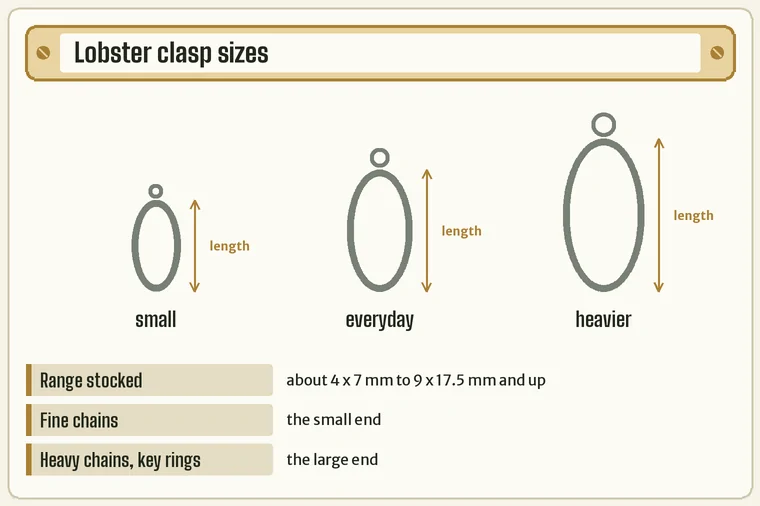
The lobster clasp, with its sprung gate, is the standard fastener on chains. Clasps are listed by two measurements in millimetres, width and length, and a specialist supplier’s range runs from about 4 by 7 mm up to 9 by 17.5 mm and beyond. The small end suits fine chains and light bracelets; the large end suits heavy chains, and the biggest trigger clasps end up on key rings and bag charms.
Choose by the chain, not by taste: a heavy clasp on a fine chain drags it round to the front, and a tiny clasp is hard to open with cold fingers. Larger clasps with a bigger lever are kinder to anyone with stiff hands. Check the clasp’s own ring is big enough for the jump ring that will join it to the chain, and match the finish so the repair does not show.
Jump rings: wire gauge, then inside diameter
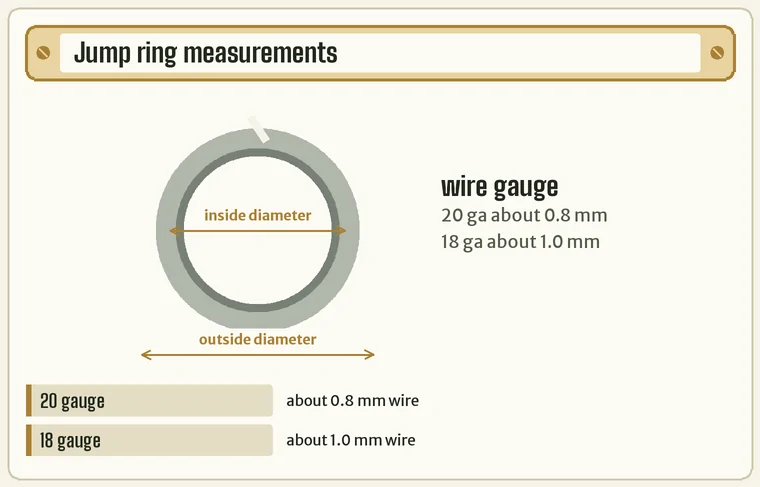
A jump ring has three measurements: the wire gauge (its thickness), the inside diameter and the outside diameter. Many suppliers list only two, and some patterns use outside diameter while others use inside, so read the listing carefully. In the American wire gauge most findings use, 20 gauge is about 0.8 mm and 18 gauge about 1.0 mm; a higher number means thinner wire.
The two diameters differ by twice the wire thickness: an 18 gauge ring with a 5 mm inside diameter is about 7 mm outside. For fine necklaces a thin wire with a 3 to 4 mm inside diameter is typical, for bracelets something sturdier. To open a ring, twist the ends sideways with two pairs of pliers rather than pulling them apart, which keeps the ring round and lets it close flush.
Earring backs and the post they grip
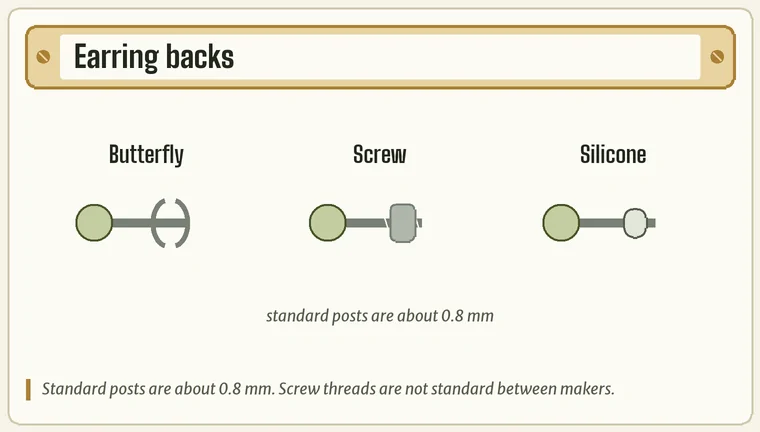
Butterfly backs, also called push or friction backs, are the most common. They grip by friction on a small groove in the post and are made for standard posts of about 0.8 mm (20 gauge) up to about 1.0 mm. They are cheap, sold by the dozen, and they loosen over time, which is why they are lost so often.
Screw backs need a threaded post and are not interchangeable between makers, because threads are not standardised even at the same gauge; only buy them if your earrings already have threaded posts and the listing states the thread. Silicone backs push onto a plain post and are a comfortable spare. Measure the post thickness before choosing, and check whether the post has the groove a butterfly back needs.
Finish and metal on a findings listing
Findings are sold in finishes as well as sizes: silver-coloured, gold-coloured, rose and black, either as plated base metal or as solid metal. For a repair the finish matters more than anything else visible, because a bright new clasp on a worn chain is the first thing anyone notices.
A listing should say what the finding is made of; if it does not, assume plating. We do not test metals, and 100buy’s warehouse checks colour against the option you picked rather than what the metal is. If skin sensitivity is a concern, that is a question for the seller before you buy, and the answer should be in writing on the listing. A mixed findings pack in one finish is usually the most useful single purchase.
Plain findings rather than charm packs
Mixed jewellery-making kits often bundle charms with the useful parts. For repairs, a plain findings pack (clasps, rings and backs in a few sizes and one finish) does more than a big kit full of pendants you will never use, and it keeps you clear of charms shaped like someone else’s logo, which this drawer leaves out entirely.
The pack quantity is again the thing to read: “100 pcs” on a jump ring option is normal, and a single clasp on its own is rarely sold. Keep the spares in a small labelled box with the size written on it; the next time a clasp fails, the measurement is already done. That box is the whole idea of this site in miniature.