
Laces, insoles and cords in the 100buy Spreadsheet, sized by what you already own
The soft parts of the drawer: laces bought by eyelet count, tips matched to lace thickness, insoles traced from the old liner, and the cords and cord locks on hoods and waistbands.
Laces, aglets and the eyelet count that sets their length
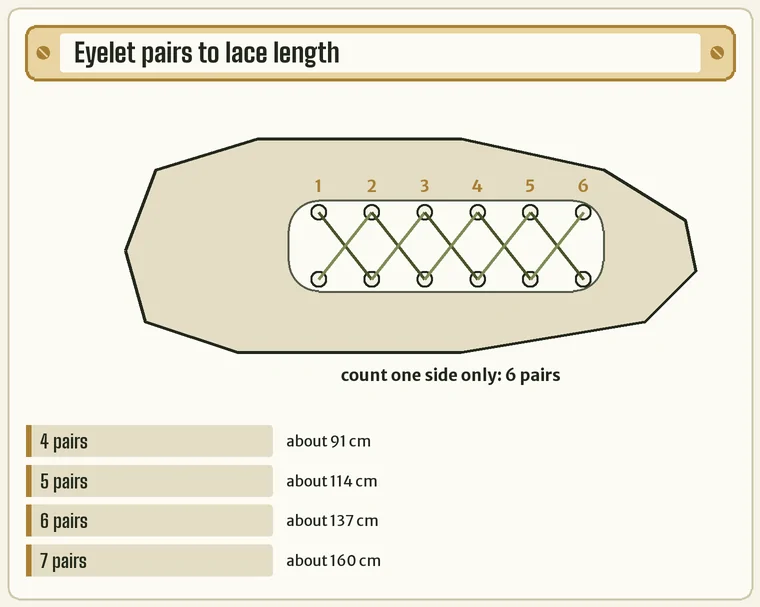
Lace length follows from one count: the number of eyelet pairs, counted down one side of the shoe only. Lace charts turn that count into a length, and although sellers differ by a few centimetres they agree on the shape. A common chart reads roughly 91 cm for four pairs, 114 cm for five, 137 cm for six and 160 cm for seven, with boots running longer still.
Two things push you to the next length up: eyelets set far apart across the shoe, and lacing to the very top with a generous bow. If you still have one of the original laces, measuring it tip to tip beats any chart. Laces are sold as a pair, by length in centimetres, and a parts listing worth buying states that length in the option rather than describing the colour alone. Some cards give inches as well, so a 45 in lace and a 114 cm lace are the same length; it is worth converting before deciding two listings differ.
Flat, round and oval laces
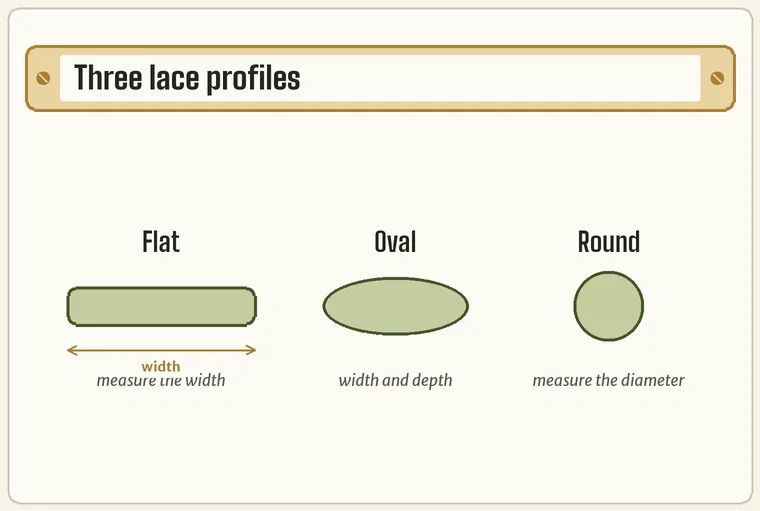
Laces come in three profiles. Flat laces are woven as a ribbon and lie flat across the tongue; round laces are a tube or a cord and run through small eyelets easily; oval laces sit between the two. The safe rule for a replacement is to match the profile you took out, for two practical reasons: a thick round lace may not pass through small eyelets at all, and a flat lace swapped for a round one changes how a knot holds.
Width matters as much as profile. A wide flat lace bunches in eyelets made for a narrow one, so measure the old lace flat across and look for that width in the listing. Thickness also decides which replacement aglet will grip it, which is the next section. None of this needs the shoe to go anywhere: laces are the simplest part in the whole drawer to get right once the length and width are known.
Aglets, the tips that make a lace thread
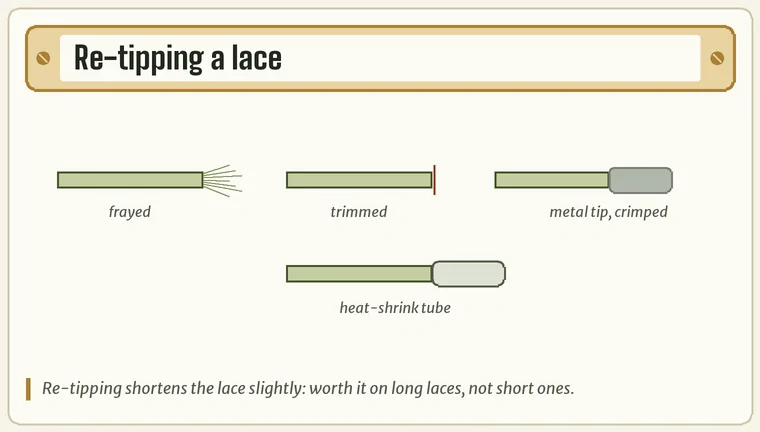
The aglet is the stiff tip at each end of a lace. Once it splits, the lace frays and stops threading through eyelets, and that is usually the end of a lace that is otherwise fine. Replacement tips come two ways: small metal tips that are crimped closed with pliers, and plastic tubing that is slid over the end and shrunk tight with heat.
Either way the tip has to match the lace thickness, so measure the lace where it is still intact. Packs usually hold ten or more, which is enough for several pairs of shoes and for the cord ends on a hoodie, which take the same kind of tip. If a lace is short already, re-tipping it makes it shorter still, because the frayed end has to be trimmed off first; in that case a new pair of laces is the better buy.
Insoles trimmed against the liner they replace
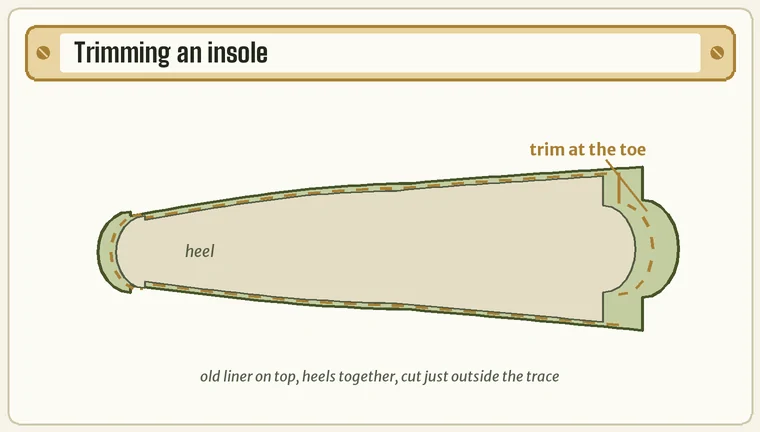
Replacement insoles are sold in size ranges rather than exact sizes, and you trim them down. Many have size lines printed underneath, but shoes of the same nominal size differ inside, so the old liner is the better guide: lay it on the new insole with the heels together, trace round the toe, and cut a little outside the line before testing and trimming again.
Trim only at the toe; the heel cup and the arch are shaped and should not be cut. A pair is the normal unit, and the size range on the label is the thing to read in the listing. This drawer stops at the replacement itself: choosing a shoe size is a different question with its own guides, and an insole will not turn a pair that is too small into a pair that fits.
Drawstrings, cord locks and toggles for hoods and waistbands
Hood cords and waist drawcords get pulled out in the wash or chewed at the ends. To replace one, measure the old cord end to end with the hood or waistband laid flat, and note whether it is flat or round and how wide; flat cord sits differently in the channel from round. A safety pin fixed to one end is the usual way to feed a new cord through.
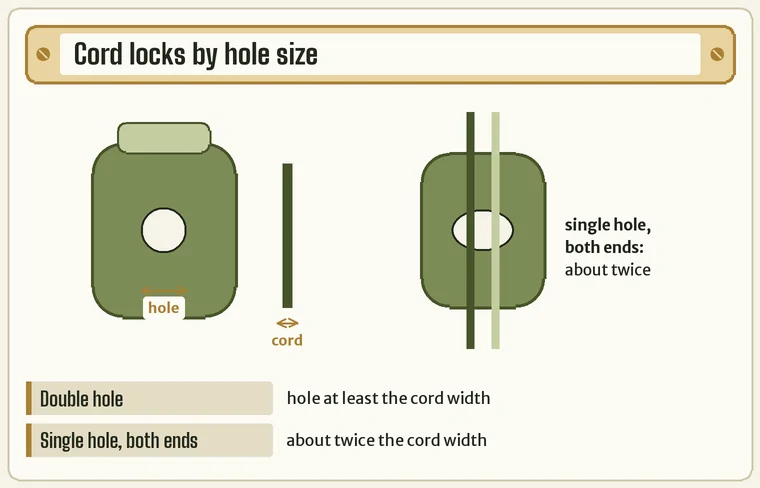
Cord locks, the spring toggles at a hem or hood, are sized by their hole. The hole must be at least as wide as the cord, and a single-hole lock that takes both ends of a cord needs roughly twice the cord’s thickness. Listings normally give the hole in millimetres, and 3.5, 4.5, 6 and 8 mm are typical. Locks are sold in packs of ten or twenty, so check the hole size in the option text rather than the photo.
Cord by the metre or in cut lengths
Drawcord listings sell two ways. Cord by the metre lets you cut exactly what you need and fit your own tips; cut lengths come ready-tipped, in a few set lengths for hoods. The first is better for joggers and shorts, where waist cords vary a lot, and the second for a hoodie when you simply want the old look back.
Read the unit carefully: a listing price may be for one metre, for a ten-metre reel, or for a single cut cord, and the option text is where the seller says which. Colour is the other trap, because white and off-white cord look identical in a listing photo and very different on a black hoodie. When colour matters, this is a good place for a warehouse photo, which can show the colour against the option you picked.