
The 100buy Spreadsheet shelf by shelf, opened at the spares drawer
Every shelf of the catalogue, with the parts that usually fail on its items and the number a replacement depends on. Shelves with nothing to replace are listed too, so the index is complete.
All 16 Spreadsheet categories
Each image links to the corresponding catalog category. Start with these buying checks, then use the specialist notes below. Listing details and agent restrictions must be confirmed for your own order.
 SneakersCompare the length and width, not only a size label.
 OuterwearCheck lining, closures and garment measurements.
 HoodiesRead the chest and length measurements.
 T-shirtsCompare the selected print, fit and fabric description.
 JeansMeasure waist, rise and inseam against a pair you own.
 SweatpantsCheck waistband range and leg measurements.
 WomenswearUse the item measurements; sizing varies by seller.
 JerseysConfirm the exact version, size and print options.
 BagsCheck dimensions, included straps and closures.
 HatsCheck crown size, adjustment and construction.
 BeltsCompare usable length, width and buckle fit.
 EyewearRead frame dimensions; a photo does not prove UV protection.
 PerfumeConfirm purchase and shipping eligibility before payment.
 JewelleryCheck material claims, measurements and included pieces.
 WatchesVerify the model and shipping restrictions, including batteries.
 ElectronicsConfirm the exact model, input rating and permitted route.
A drawer of replacement pieces for every catalogue shelf
This is the Spreadsheet page of the drawer: every shelf of the catalogue, opened at the parts that keep its items going. Each entry names the shelf (the link opens it), the parts that usually wear out on that kind of item, and a line on what to measure. Where a shelf has nothing worth replacing, the entry says so rather than inventing a part.
Shelves are grouped by the hardware they share, so trousers, jeans, joggers and shorts sit together because they share waist fastenings, and bags sit beside key rings because they share clips and rings. The drawer pages linked in each group explain the parts in detail; this page is the index you can scan in a minute.
Coats, jackets and hooded tops: zips, snaps and cords
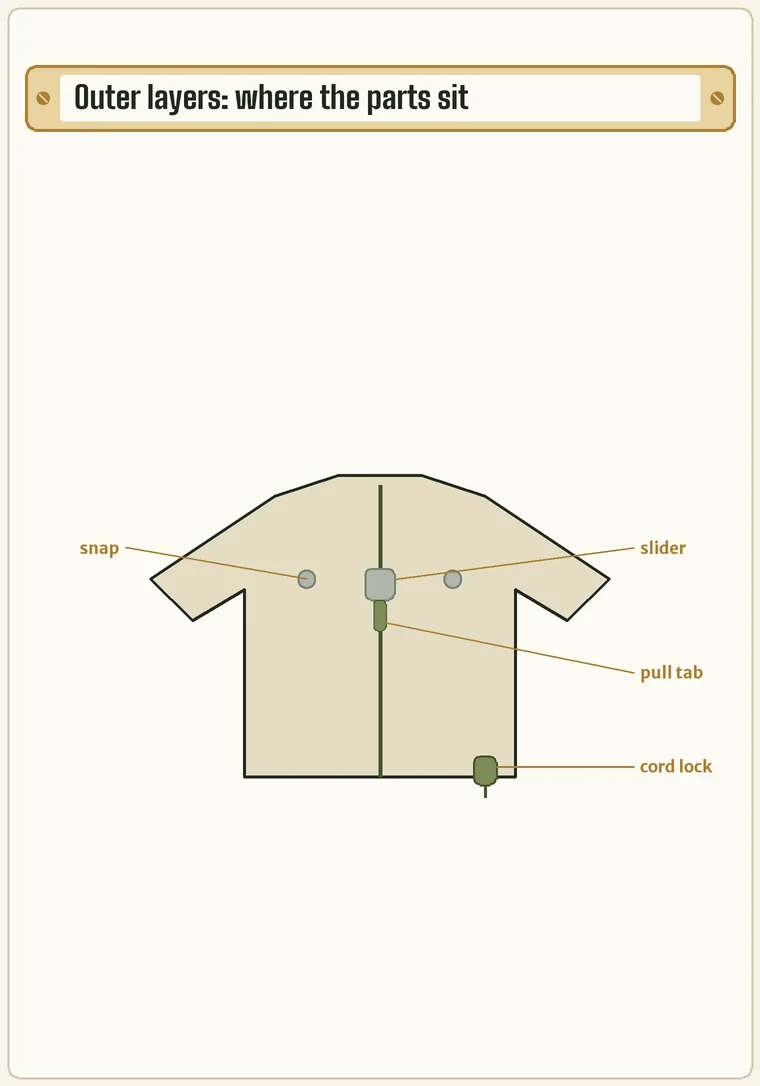
- Coats and outer layers Category
Zip slider, pull tab, cord locks at hem and hood
Long coats and parkas usually have a separating zip, with a box and pin at the bottom; the slider and the tab are the parts sold on their own. Measure the closed teeth before buying a slider. Zips drawer.
- Light jackets Category
Snap fasteners, zip pull, cuff buttons
Work and overshirt-style jackets lean on press studs. A replacement set must match the cap diameter, and setting it needs a small hand tool. Snap fasteners.
- Hooded tops Category
Drawstring, cord ends, zip pull on zip-ups
Hood cords pull out in the wash and the plastic tips split. Measure the old cord end to end and note whether it is flat or round. Drawstrings.
- Jumpers Category
Cardigan buttons
Jumpers themselves have nothing to swap, but cardigans lose buttons. Count the holes, measure the face in millimetres and convert to ligne before you look. Buttons by ligne.
Trousers, jeans, joggers and shorts: fastenings at the waist
- Trousers Category
Waist button, fly zip slider, hook and bar
Chinos and tailored trousers usually take a sew-on button and a short metal fly zip. A fly slider is sized like any other: measure the teeth. Zips drawer.
- Jeans Category
Tack button, fly zip slider
The jeans button is a tack button hammered through the denim, not sewn on; 17 mm is the usual size. Rivets on the pockets are not a part you can sensibly replace. Tack buttons.
- Joggers Category
Drawcord, aglets, eyelets
Joggers lose the waist drawcord through the eyelets. A cord sold by the metre plus a pack of aglets is the usual fix. Cords.
- Shorts Category
Drawcord, cord ends, snap at the waist
Nylon and swim shorts often have a flat drawcord and a single snap. Measure the cord width as well as its length.
Trainers and sandals: laces, insoles and straps
- Trainers Category
Laces, aglets, insoles
Count the eyelet pairs on one side of the trainer and buy the lace length that pair count calls for; insoles are trimmed against the old liner. Laces drawer.
- Sandals and sliders Category
Buckles on straps, hook-and-loop tabs
Strap sandals use small pin buckles sized by strap width. Moulded sliders have no hardware to replace.
Bags, rucksacks, wallets and key rings: buckles, clips and rings
- Rucksacks Category
Side-release buckles, ladder locks, zip pulls
Rucksack buckles are sold by the webbing width they take: 20, 25, 38 and 50 mm are the widths you will see most. Straps drawer.
- Bags Category
Swivel clips, D-rings, strap, zip pulls
Shoulder bags wear at the clips. A swivel clip is sized by the inside width of its eye, which must match the strap.
- Wallets Category
Press studs, zip pulls on purses
Wallets mostly have nothing to replace; zip purses take a small coil pull and card wallets a single snap.
- Key rings Category
Split rings, lobster clasps, swivels
Key rings open up under weight. Split rings are sold by outside diameter, clasps by length. Key ring parts.
Caps, belts and scarves: closures and buckles
- Caps Category
Snap strap, strap and buckle, sweatband, top button
A cap’s back closure is a standard part: plastic snap straps come as a pair, fabric straps with a slide buckle. Cap closures.
- Belts Category
Plain buckles only
A belt buckle is sized by the strap width it takes. Only plain, unmarked buckles belong in this drawer; see why on the ordering page.
- Scarves Category
Nothing to replace
Scarves have no hardware. The shelf is listed so the index is complete.
Glasses, watches and jewellery: the small metal parts
- Glasses and sunglasses Category
Nose pads, hinge screws, temple tips
Check how the pads attach (screw-in, push-in or slide-on) before anything else; the three are not interchangeable. Frames drawer.
- Watches Category
Strap, spring bars, buckle, keeper
Measure the gap between the lugs. The strap and its spring bars are bought to that width. Watch straps.
- Jewellery Category
Clasps, jump rings, earring backs
Findings are sold by length, wire gauge and inside diameter. Plain findings only. Findings drawer.
Shelves where the drawer stays empty
- T-shirts Category
Nothing to replace
T-shirts have no hardware. When a print cracks or a seam goes, there is no part for it here.
- Socks Category
Nothing to replace
Listed for completeness; socks are sold in packs and replaced whole.
- Women's clothing (search results) Search results
Concealed zips, hooks and eyes
This is a search across women’s clothing rather than a single shelf. Dresses and skirts use concealed zips, sized like any other zip by the closed teeth.
- Sports shirts Category
Nothing in this drawer
Sports shirts have no replaceable hardware, so the drawer for this shelf is empty.
- Fragrance Category
Nothing in this drawer
Atomiser caps and pumps are made for one bottle neck, so the shelf has no standard spare.
- Electronics Category
Outside this site
Electronic parts are not covered by this drawer: they are device-specific, and this site sticks to plain hardware.
- Headphones Category
Outside this site
Ear tips and cables are device-specific and electronic, so they sit outside this drawer.
Picking a parts listing that states its size
How to pick a listing for a small part comes down to whether the listing commits to a size you can check. A good parts listing puts the size in the option name itself (a slider option reading “5# coil, black”, a strap option reading “20 mm”), shows the part next to a ruler, and says how many pieces one purchase gives you. A listing that shows a lovely photo and offers options called “A”, “B” and “C” leaves you guessing.
Parts listings also tend to bundle: a single option might be a pack of ten, a pair, or one piece, and the price per option hides which. Read the option text and the pack quantity together before deciding, and prefer the listing where the photo shows the exact pack you will receive. If the option names are in Chinese, the size is usually still written in digits with mm or a size mark you can read.
Seller signals on a listing for small parts
For parts, good sellers are the ones who sell hardware as hardware: a shop that lists sliders in every size and tooth type, or watch straps in every lug width, is more likely to have a size chart and measured photos than a clothing shop that happens to sell one replacement pull. Those seller signals matter more than a big sales figure, which on a cheap parts listing mostly tells you the item is cheap.
Other signals worth a glance: whether the shop answers questions about sizes in its listing text, whether the photos look like they were taken of the actual stock rather than copied, and whether the same part is offered in a sensible range of sizes. None of these is proof, and we do not score shops. They simply raise the chance that what arrives matches the number you measured.
Checks before paying for a part
A few mistakes come up again and again with small parts, and all of them are avoidable before you pay. Run through these before you order:
- Measured the old part, not the listing photo, and written the number down with its unit.
- Matched the type as well as the size: coil, moulded or metal teeth; screw-in or push-in pads; flat or round lace.
- Read the pack quantity in the option text, so you know whether you are buying one piece or twenty.
- Checked the part carries no maker’s lettering or logo. Plain hardware only.
- Planned which parcel the part will travel in, so a tiny bag does not ship alone.
The last point is about postage rather than fit, and the ordering page explains it with a dated example from 100buy’s own shipping estimate.